Boings Idea
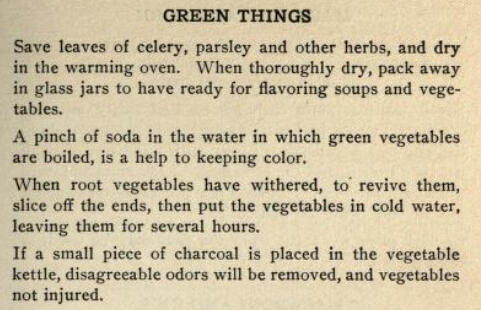
Since isn't much to this website, yet, to make your visit a little more worthwhile, here are some tips on what to do with "Green Things" from Progress Meatless Cook Book, by Carlotta Lake © 1911:
Located on the traditional land of the Ohlone people. If you aren't familiar with the traditional territory of where you live, please explore Native Land Digital.
Lotus Clair Samuel
• Autodidactic and curious.
• Resourceful.
• Systems thinker.*
• Pragmatic and creative.
* I dislike the phrase "systems thinking", because it is redundant, however, buzzwords can be useful shorthand.
Experience
I have industry experience in the following fields 1
• advanced materials,
• clean technology,
• economic development,
• healthcare,
• management consulting,
• operational efficiency,
• relief and reconstruction,
• robotics,
• supply chain transparency and traceability,
• supply chain water risk,
• sustainability,
• venture capital.While working at the following types of institutions 2
• venture capital studio,
• venture capital (emerging),
• think tank,
• startups (early-stage),
• startup incubator,
• private services firms,
• nonprofit,
• international finance institution,In the following roles 3
• Chief Operating Officer,
• Head of Compliance,
• de facto Chief Financial Officer,
• VP of Finance and Operations,
• Operations and Supply Chain Consultant,
• Independent Business Consultant,
• Strategy and Business Lead,
• Financial Analyst.Executing on 4
• compliance,
• due diligence,
• growth planning,
• change management,
• nondilutive funding,
• tactical operations,
• new venture spin-out,
• organizational review,
• system and process design,
• market research and analysis,
• strategy design and execution,
• multi-entity ecosystem management,
• financial planning and forecasting.
Notes on listing order
1 Alphabetical ascending.
2 Alphabetical descending.
3 Chronological descending.
4 Number of characters ascending.
Education
• Bachelors in International Development Studies, with a minor in cultural anthropology, from UCLA.
• MBA from Georgetown University.
See here for a little about my startup and venture capital studio experience.
Lotus Clair Samuel
change management, compliance, and risk mitigation for private equity and startups.
• Alignment of strategic and tactical operations.
• Internal review for organizational weak spots and regulatory compliance.
• Guidance during transitions; from change management and M&A to personnel planning and financial forecasting.
Some of the companies I've worked with
"labs"
Backstage Capital and Studio - a venture lab
Greentown Labs
JoyLabz
Otherlab
Sourcemap (started at the MIT Media Lab)
Vital LabsPlaces that are an acronym with a "C"
BCG
CCG
IFC (part of the World Bank Group)Independent (non-lab) early stage startups include:
Dashboard Earth
Tall Poppy
See here for my "CV", it shows a wider range of my work experience.
California beer map key and notes
California Beer Map key and notes for the Google Map found here
contact [email protected] with questions or suggestions.
This is a hobby project, not associated with any brewery or otherwise.
Primary source information is the California ABC (Alcoholic Beverage Control), found hereScroll down to see screen capture of what the map looks like.
Key
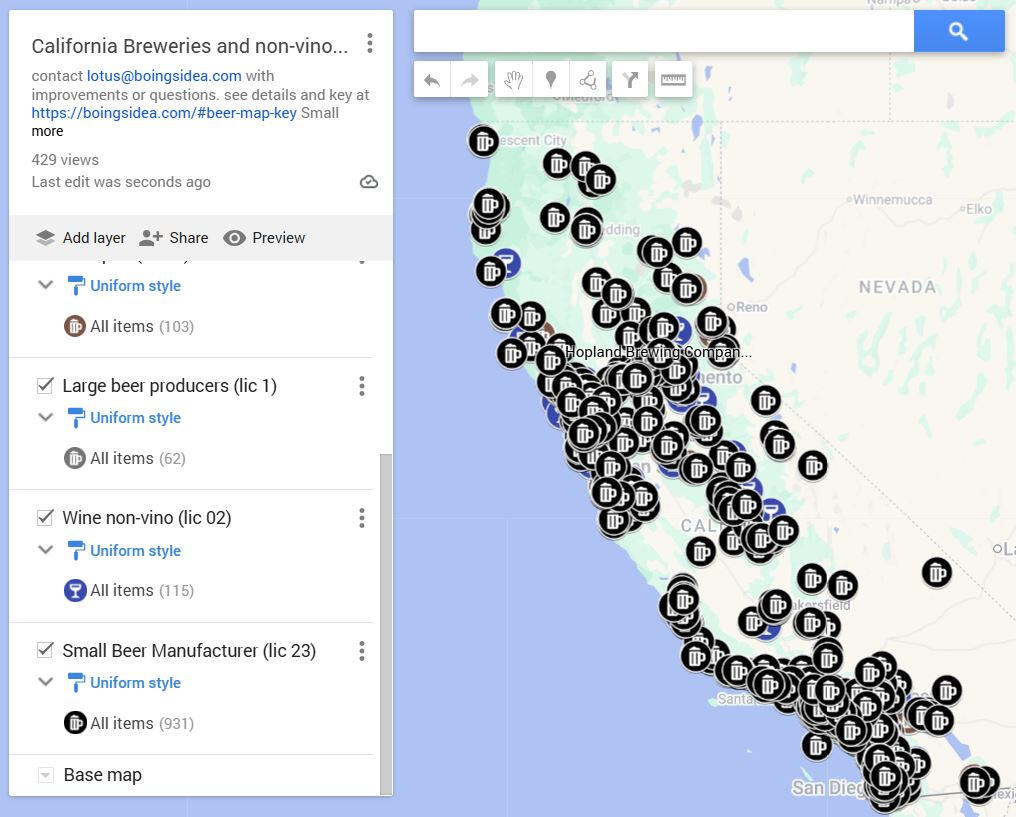
Color and Icon Key.• Black beer stein: "Small Beer Manufacturer" <60k barrels/year, license 23.
• Gray beer stein: "Beer Manufacturer" >60k barrels/year, license 1.
• Brown beer stein: Brewpubs and other licenses, spread across two layers: License 75 and Other. (see notes.)
• Blue wineglass: non-malt and non-vinifera ferments, mostly cider and sake, license 2 "Winegrower".
California ABC (Alcoholic Beverage Control) license types are here
Individual locations notes• edit map: information provided to ABC doesn't always match that in the real world. Some examples: (1) the location doesn't drop at the correct spot in Google Maps. (2) the name or location provided to ABC doesn't match that used by the business. This is an flag to check name or location before visiting. See the notes in the entry for details.
• (m)ultiple ABC registrations: examples (1) a single brewery has multiple brewing licenses at different locations (2) a brewery has a satellite taproom that doesn't have a brewing license, these locations will appear on another layer, e.g. brewpub or Other (3) the business has both a taproom and a production facility, in which case the production facility will not appear on the map. (4) they are moving locations and the old one is still registered. If you see an entry flagged with an "m" but there's only one location on the map, that's likely because I removed the other location since it is only for production, an office, or similar. I have tried to capture at least one location for each company, while also removing locations that aren't open to the public.
• (s)hared facility: it's relatively common for businesses to share space or equipment, in which case pins/flags might overlap with another place.
• (p)roduction only: left on the map for reference and learning more. You might be able to visit by special appointment. If they don't have an "m" (for multiple location) these listings do not have another taproom location.
Notes
• The objective of this map is exploration and curiosity. For example of how this might be reflected in the map: where a brewery lists two locations and one is not open to the public, I've removed that listing (that isn't open to the public) as this is how you can find and experience the beer; however, f there is only one listing and it isn't open to the public, I've left it, as a starting place to learn more about the brewery.
• Click on the down arrow, in each layer, to expand the list and see the business names alphabetically.
• Before visiting, verify status. Visiting might not be an option or status might have changed. As a note, during the import into Google Maps, some data doesn't translate accurately and I've tried to note or capture this when possible (this usually happens when the address given to the ABC doesn't match what Google Maps likes as a format).
• There will at times be a lag between breweries closing and their permits expiring, or their permits being granted and their being open to the public.
• The number in the layer titles refers to the California ABC license.
• The Taproom and Other layer captures a few types of establishments. A few examples (1) a brewery's non-brewing taproom (2) a brewery in planning and I wanted to add it in case it opens before I update the map when I am in the area. It does not include most pub-chains (e.g. BJ's) because that just isn't what this map is about - the BJ's that have brewing licenses are on the map.
• Many brewpubs licensees don't appear to be actively brewing, or just brewing a single beer and serve many guest beers. They often look like nice options for a beer, but not necessarily if you're looking for house made beer.
• Cider and sake (under the "Winegrower" license) are on the map. As is mead at this time, though it creates a logical consistency since I have removed kombucha from the beer map (see below). I don't know why mead is a wine but kombucha is a beer.
• Kombucha has been removed from the Small Beer Manufacturer layer, since I don't view it as beer (there is no grain base). If you love kombucha and want this information, contact me and I'll send it over or create a map specifically for this.
Process Note
Rough outline of the process
1. I export the information from the California ABC here, to a csv.
2. I then clean up the information in Excel. In early versions this was just to make the addresses readable and other general edits. However, I have now started to add information, like notes and URL. See Key.
3. Upload into Google Maps. In Google Maps there is a way to edit the information in a spreadsheet style interface.The Taproom and Other layer is much more ad-hoc, since it captures places that are not Brewing nor Winegrowing licensee.The non-vino ferments layer requires the most cleanup. The raw data from ABC is well over six thousand registrations with a number 2 license, "Winegrower". (Sometimes I accidentally refer to this as "Winemaker", this is simply because wine nomenclature trips me up.) The first round of cleanup with this was mostly just using formulas to search for terms such as "cider" and "farm". Further cleanup was to incorporate other sources and further refining of the list. This results in about one hundred licensees that aren't (only) vino (i.e. grapes), some places make wine and another ferment. Why not include a wine-only layer? Because there are plenty of other sources to find wine and wineries, and that's not my jam. Beer is.
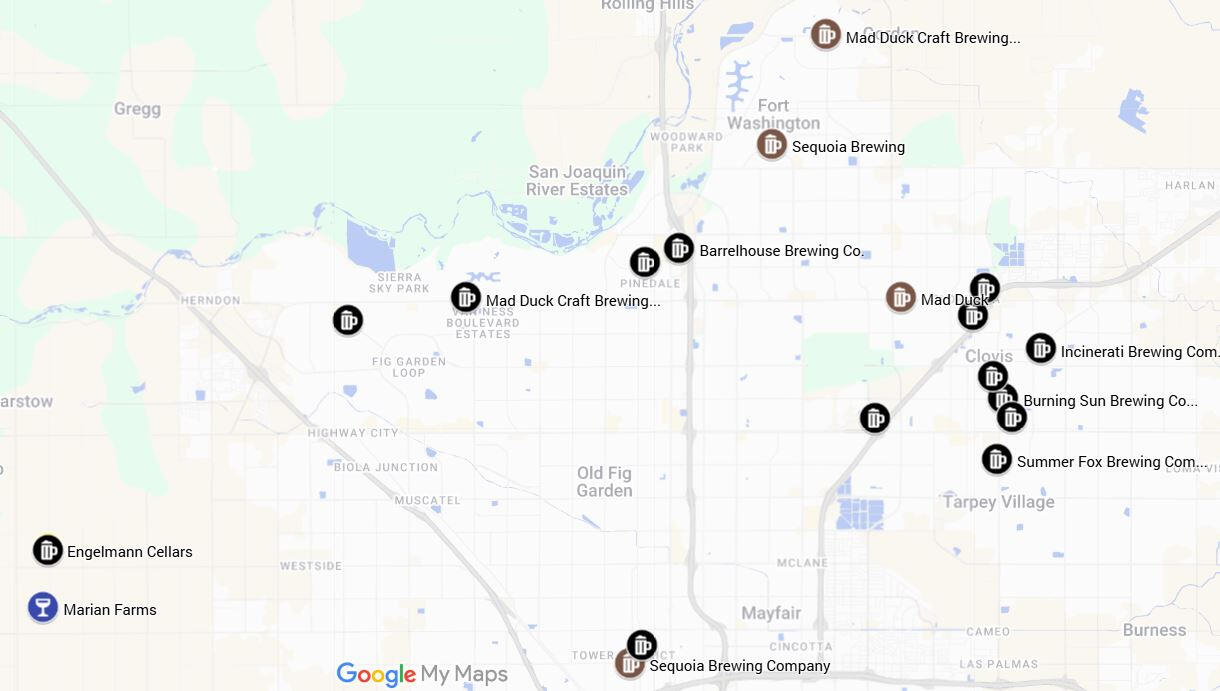
Below is a screen shot of the whole map and one of it zoomed in on the Fresno area.